Consciousness work: what, why, how
There are matters more important than technology, and becoming more conscious of what is going on in your experience, and thus more free and powerful, is one of those.
(This is a transcript of my 10 min talk on the topic. You may or may not prefer watching it instead of reading.)
We are enslaved by anything we do not consciously see.
We are freed by conscious perception.
I love this quote because it expresses so well what consciousness work is primarily about for me.
So what is consciousness work?
Look into your experience to become more conscious of what is going on and what is actually true.
This is about experience. And experience is all you have, there is nothing for you other than your experience. The quality of your experience is the quality of your life. I am sure that is something you deeply care about.
Consciousness work is about increasing your consciousness of what is true. And this is all about your experience. It doesn’t help if you intellectually understand what is going on. It doesn’t help if you believe something. You need to discover these things for yourself, in your own experience. Only then can this have any impact on your experience. Consciousness work is not a belief system, it is not an intellectual exercise, it is an experiential discovery.
There is a lot going on in your experience that you are not conscious of. Yet it has an immense impact on you.
An example: Imagine seeing a person in an ugly Christmas sweater. This seems to be a simple, even trivial event. Yet you just went through a rather complex process to arrive at this observation. A native from a jungle wouldn’t think of ugly, or Christmas. Perhaps not even of a sweater. Their experience would be very different from yours.
Our experience includes far more than the objective reality of things, body, and action. How we experience reality is based on many foundational assumptions and beliefs, many so deep that we take them for facts, never realizing that they are just mental constructs. Some of them may be true (yes, the Earth is round!) but some may be wrong. There is also a lot we add ourselves - our interpretations, emotional state, emotional reactions, judgements. We mash all this together and say “this is an experience happening to me”. We don’t distinguish between what is actually true, and all the other stuff we are adding.
Why should you care about consciousness?
Why does this matter? Why should you care about increasing your consciousness?
I will give you three reasons: freedom, non-suffering, effectiveness.
Imagine you are standing in a queue and someone sneaks to the front. You get angry, and think: “this person made me angry”. Now you are a victim of the anger, there is nothing you can do about it, it has been imposed upon you. When you really, experientially, realize that you made yourself feel angry because of what they did and your ideas about right and wrong and assumptions about why they did it - then you become free to change your reaction. You aren’t a victim anymore, you are in the driver seat of your life. When you become clearer on what is really true and what is being created by you then you gain the freedom to change what you are doing. It becomes possible to understand and change your habitual patterns of behavior and emotional reactions, and discard those that are ineffective or even harmful.
Next: Most of our suffering, if not all of it, is created by ourselves, by the thoughts we are making in our heads. You worry because you are imagining a negative future. You feel shame about something you did in the past because of what you believe happened, what it meant, and what should have happened. When you become conscious of how much of your experience you create, and how, then you can drop a lot of this painful and unnecessary mental activity.
And as you become better at distinguishing true from not true, you can also relate more to what is actually there. For example, when you interact with someone, it is not just that interaction taking place. You bring into it your whole life, your beliefs and values and ideas, and you bring in the whole history of your past interactions with this person. You bring in so much that it is almost impossible to see what is actually occurring now. When you can separate these two and relate more to what is actually there, your interactions become more effective. This applies to any activity, including such important ones as communication and relations.
Personal experience
I would like to share a personal experience with you. In the summer, I read a book called Ending Unnecessary Suffering. It was very well-written, very insightful, and it all made sense. I did follow the exercises suggested there, but nevertheless it has not changed my life much. Then I attended a workshop of the same name, and it blew my mind. It was one of the most transformative experiences of my life. Clearly, for me, doing this work with other people is orders of magnitude more effective.
What did it give me? It enabled me to really experience, for myself, some crap I had been doing with my mind, and stop it. Now, when somebody complains about something not being done right, I don’t go into the vortex of feeling guilty and ashamed for not having done a better job, and of getting angry at the person for seeing only what is not perfect and not appreciating all I have done right. In the physical realm, the experience enabled me to start taking cold showers again. Previously, I had always been dreading the moment I switched from warm to cold, and the whole cold shower I was miserable about how unpleasant the cold was, and wondering when would it be enough so that I could finally stop. Now, I simply don’t allow myself to think about it. I just take a warm shower and then switch to cold. And as the cold water is hitting my body, I see it just as a unique perception, without comparing it to any other perception, without judging it as bad, without going mentally into the future when this will be over. To me, this is a kind of a super power. And it is available to everyone.
The Extreme Ownership principle
We use this “extreme ownership” principle in my company, and I think it applies really well here. In this context, it sound like this:
YOU are responsible for your development
No course, no book, no guru can do this for you. They can provide useful tools and pointers, but you have to do the work.
The no beliefs & no bullshit promise
There are two things I would like to emphasize about consciousness work.
First, you are never asked to believe anything. On the contrary, you are actively encouraged to not believe a thing. You are given assertions, but they aren’t there for your to believe, or to intellectually understand. They are challenges for you to explore and validate or invalidate in your own experience. If you believe, you have failed.
Second, there is no bullshit. Only honest, deep questioning and hard work.
The tools
The tools of contemplation work are:
Study, to get tips for where to look. Deep insights are to be found in the most overlooked places
Individual contemplation, which means looking into things for yourself, non-intellectually
Guided meditation / consideration individual exercises
The “contemplate & communicate” pair exercises, also known as dyads
How - consciousness work resources
Here are some resources for you, so that you can learn better what this work is about, from people with deeper understanding and more experience than me, and so that you can take your next step.
I would strongly encourage you to go to the consciousness community site at Skool, and check out the resources there:
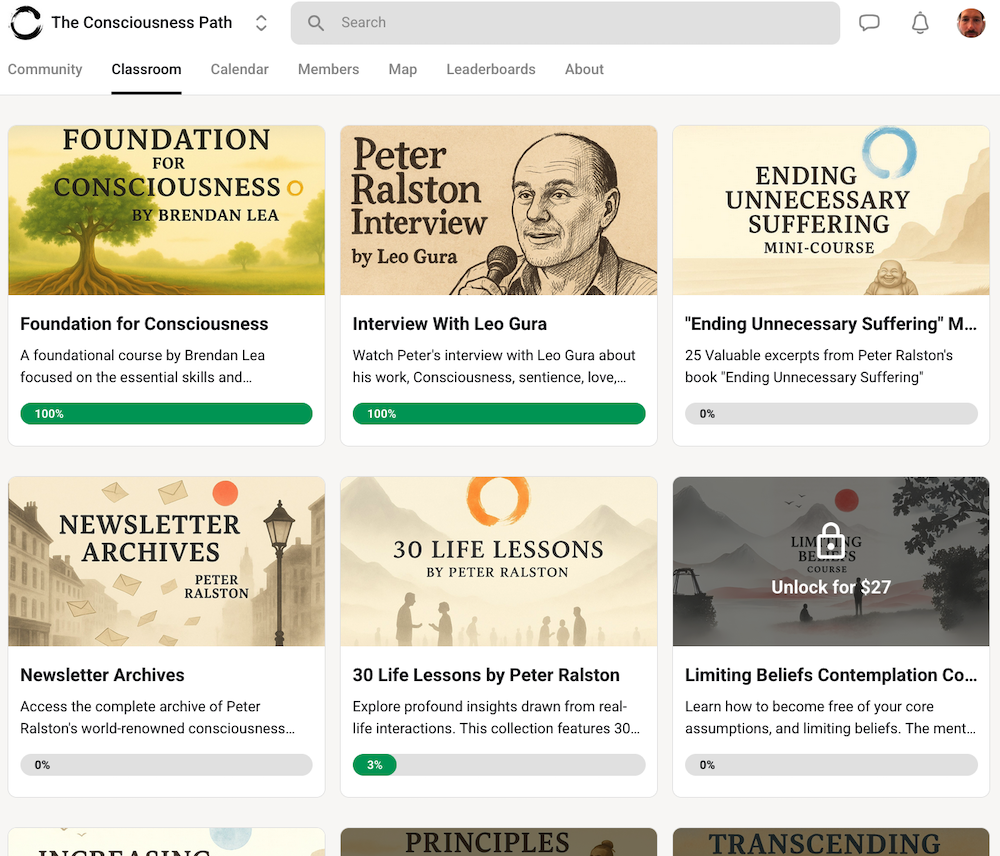
Aside of various materials and self-paced online courses, there is also a group of engaged people, sharing their insights and challenges. It is a good place to get both inspiration and help. There is also a weekly challenge, and a Zoom call connected to it, with some guided considerations, brief discussions, and dyads. It has been immensely valuable to me, and new people are most welcome. You can also access an archive of session recordings to check them out.
If you prefer a more interactive learning, as I do, then you can attend one of the weekend and week-long workshops, both physical and on Zoom (which works surprisingly well). It took me long enough to go to one, but it was incredibly valuable.
Finally, there are books by Peter Ralston. I would especially recommend the aforementioned Ending Unnecessary Suffering one. And if you want to go into more breadth and depth and foundations, check out The Book of Not Knowing.
Good luck!